Rally Dynasty
Rally Dynasty: a rally manager game
A rally century. One dynasty. No mercy.
Know the road. Or don't.

Rally Dynasty is a rally management game by an independent developer, starting in 1973 and rolling on past today. You run one family team through five regulation eras: hiring drivers, building cars, managing exact money and real time. Heirs inherit the team when a driver retires or dies. It is unofficial and unlicensed, in the spirit of the classic World Rally Championship decades. Platforms: PC (web/Steam) and Android.
A rally team manager game
You never touch the wheel. You choose the programme, the car, the crew and the tyres, and then you live with it. Pace is exact and stated in seconds. Danger is never a percentage. It is a sentence, because that is how it is actually known.
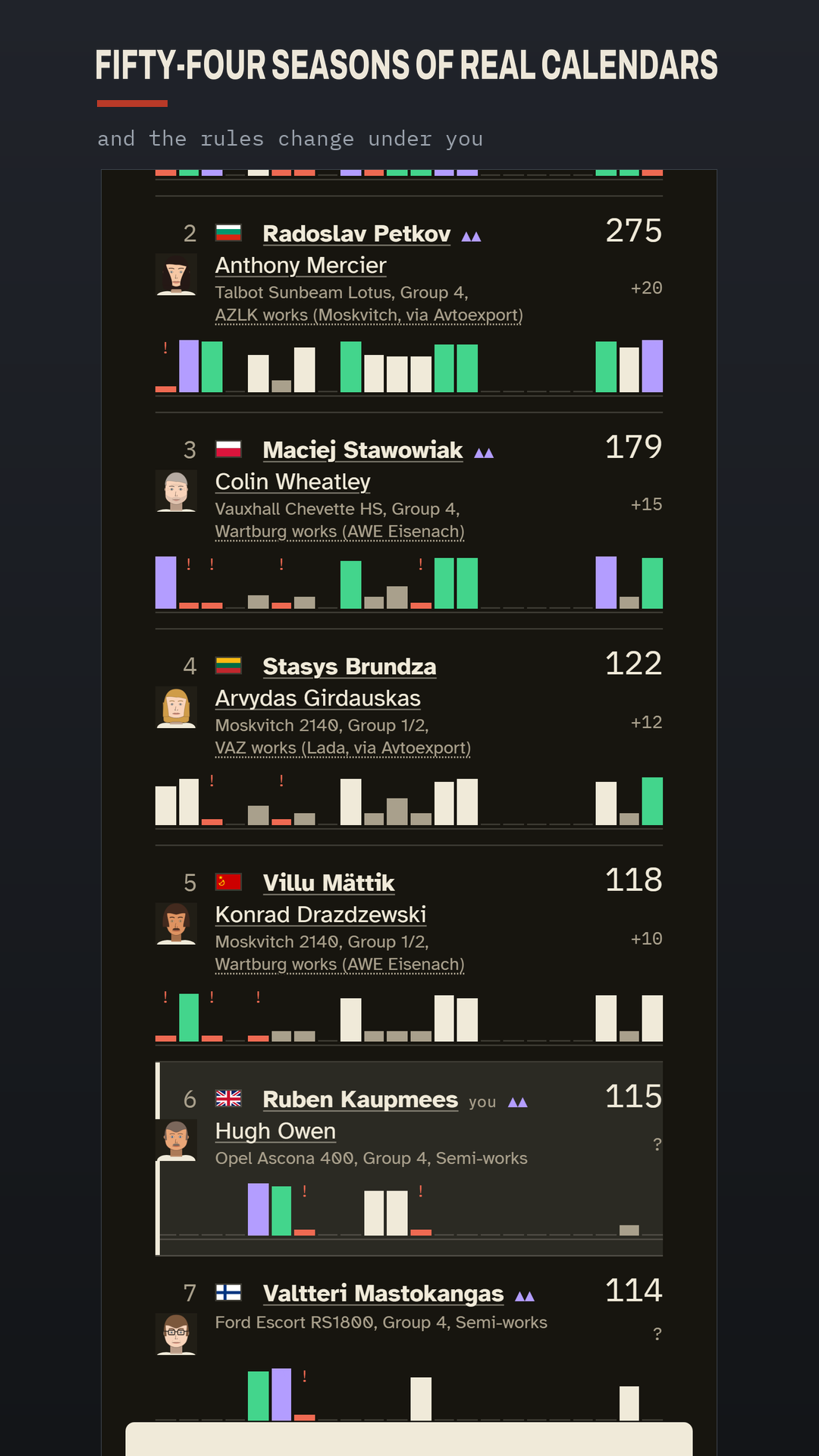
Fifty-four seasons, 1973 to 2026, then designed seasons past today. 1973 opens with a championship for makes, not drivers. Group B arrives, and then it is banned from world rounds in 1987. Central service parks end roadside repairs in 2004. Pace notes arrive at the RAC in 1990. Every one of those changes is modelled from the record and dated: era data on the Ruleset, never a year-if in the sim.
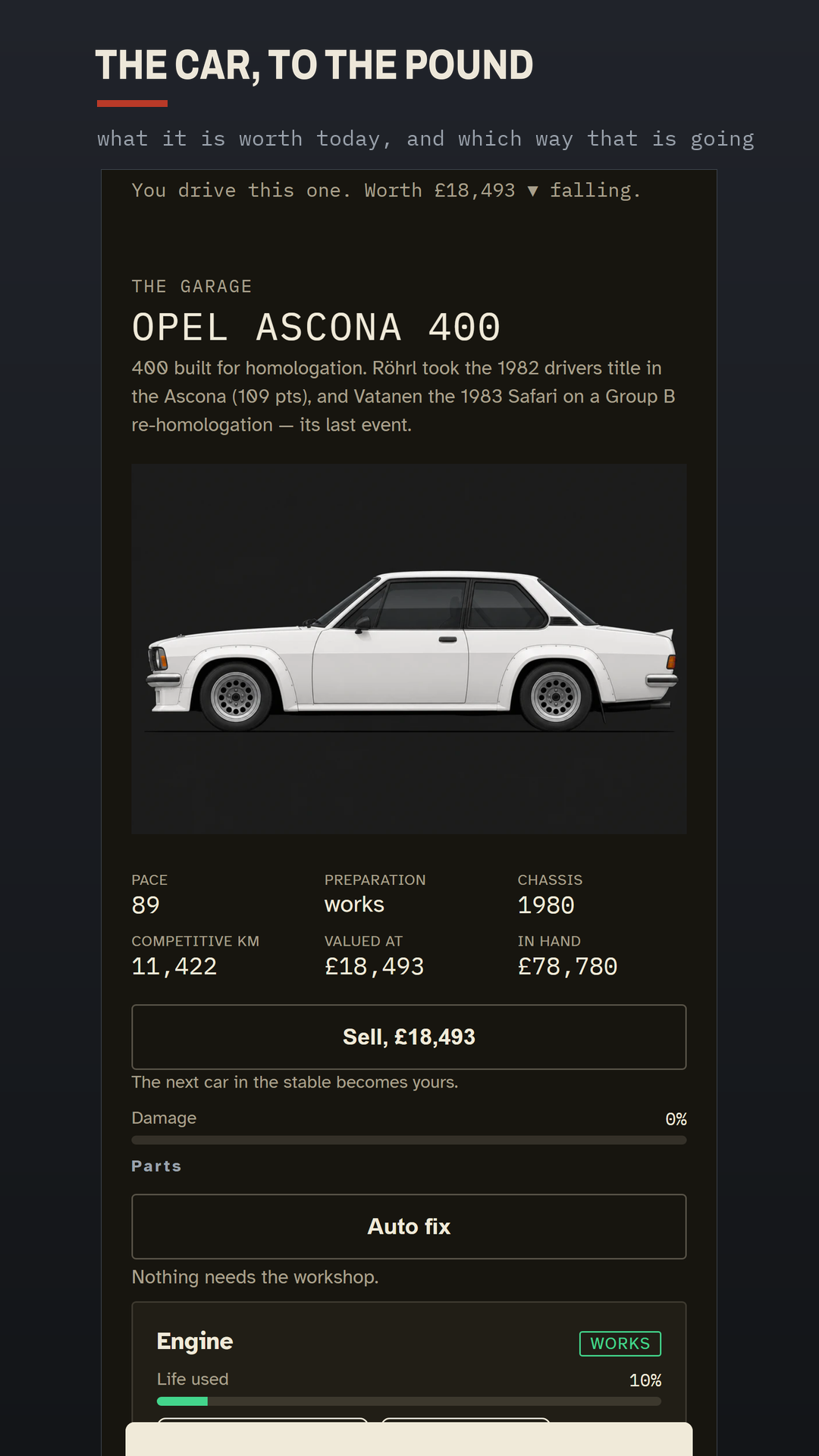
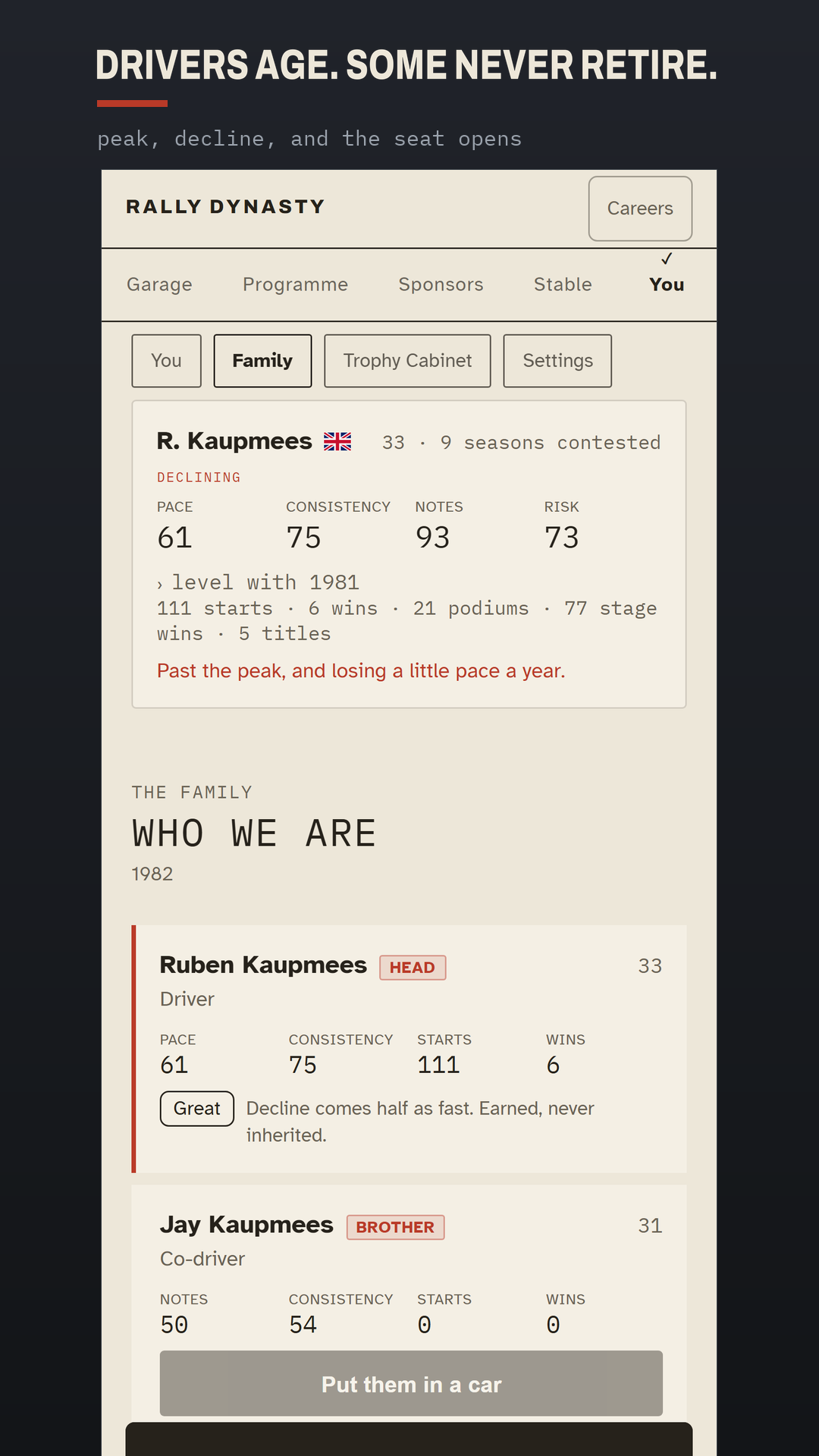
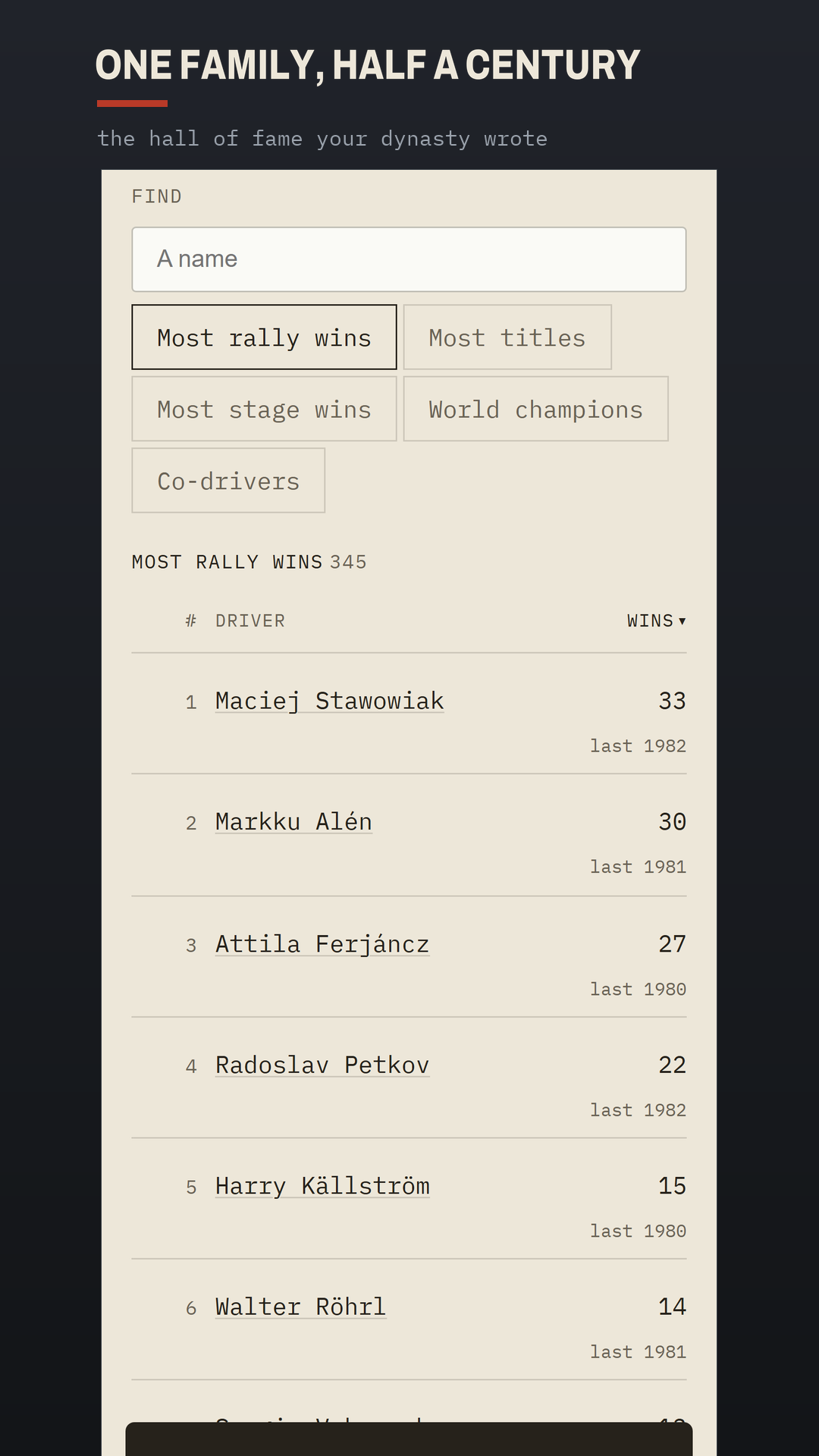
Drivers improve with competitive kilometres, plateau, decline, get hurt, and sometimes are killed, at the rate the era actually killed them. When the head of the team retires or dies, the dynasty passes to an heir. The name on the entry list stays; the person behind it does not.
Gearboxes cost what they cost. Entry fees, travel, freight, wages, sponsor retainers and prize money are period figures, in period currency. The free demo runs in your browser, starting in 1973 or 2017: the free run is the year a career starts and the two after it, and three seasons at most across your careers. Nothing else is held back. The rest of the century is one payment, once: the game on Steam for PC, or the unlock on Android. The payment does not open the 1982, 1987 and 1997 starts: a campaign reaches them by playing.
Five regulation eras
The sport does not stay still. Each boundary below is sourced to the project's research briefs and arrives as data, not as a hard-coded year branch. Finer regimes shift underneath: recce and pace notes, ice-note crews, tyre houses, road order, gravel crews, start intervals, and which passports may start which weekend.

-
1973-1981
Group 4
The championship opens as a makes-only title. A drivers' cup runs 1977-78 on its own points table; the drivers' championship itself arrives in 1979. Homologation is a capital project: 500 cars in twelve months, then 400 in twenty-four from 1976.
-
1982-1986
Group B
Two hundred cars to homologate, twenty-car evolutions, no power ceiling. The cars are barred from starting world rounds from 1987: a class ban, so the field is re-formed with era-legal metal rather than thinned. Nationals and historic still take them.
-
1987-1996
Group A
Production-based cars after the ban. The homologation floor moves to 2,500 units in 1993, and the car market moves with it. Group B stays out of world rounds for good.
-
1997-2016
The kit-car years
A kit formula from 1997. The central service park and the cloverleaf itinerary arrive in 2004. That is what ended roadside service, and it brings the Thursday shakedown with it. Control tyres follow in 2008, 1.6 turbos in 2011.
-
2017-today
The modern era
Aero cars from 2017, then a hybrid top class in 2022 and the same class without hybrid from 2025. Designed future seasons continue past the present day. A 2017 start is one of the two free careers.
Prequels will be available after launch: the Heritage Chapters, playing backwards from 1973, as free updates. Named below.
Platforms
PC (web and Steam) and Android. The browser demo is playable now. The Steam page is not public yet; nothing has been sold. The Steam page is up for wishlists; the game comes out on 15 October. Out now on Steam. Menus come in ten languages; the game's own writing is English.
Live
Play in the browser
The free demo, in your browser: start in 1973 or 2017; the free run is the year a career starts and the two after it. Phone-first; keep the tab open and it plays on without a connection. The full game is the Steam (PC) and Google Play (Android) version.
Coming soon Coming soon Out now
Steam
Out 15 October 2026, $12.99. The store page is built and submitted; it goes public as Coming Soon the moment Valve approves it, and no URL is printed here before that. Out 15 October 2026, $12.99. Wishlist it on Steam and Steam tells you the day it comes out. Out now, $12.99. Get it on Steam. The game's own writing is English; its menus come in ten languages. Rally Dynasty is the rally manager where the road is the opponent. Developer and publisher: Daniel Raissar, sole trader.
Live
Android
The same game on the phone, saves on the device.
Live
Discord
Join the Discord. Dev diary, build notes, and somewhere to argue about which era was the real one.
After launch
Prequels will be available after launch.
Three Heritage Chapters play backwards into the live save: Trailblazers (1961-1972), Pioneers (1952-1960), and Origins (1894-1950). Chapters of one book, not a second game: free updates, included in the one purchase, never sold separately.
Press and contact
Daniel Raissar, independent developer, sole trader, Estonia. Handle @rallydynasty. Website rallydynasty.com. YouTube @rallydynasty. Instagram @rallydynasty. TikTok @rallydynasty. Reddit u/rallydynasty. Facebook group. Discord invite. Contact: dynastyrally@gmail.com.
Press kit, fact sheet and FAQ are live. A dedicated press mailbox will be published when it exists; this page only lists the address above.
The Raissar dynasty
Daniel Raissar built Rally Dynasty because rallying is a family sport, and his father Ilmar Raissar was already on the map. Ilmar won USSR and Friendship Cup rounds in the 1980s on Lada VFTS metal, including Estonian championship seasons in Harju KEK Ralliklubi livery with co-driver Rein Talvar. Daniel starts the game in 1973 as a privateer with a debt-bought car; the sim is the path his father actually walked, era by era, rule change by rule change.

This is not a startup pitch deck. It is a son building the game he wishes existed, and saying plainly that if people buy it, that money is meant to leave the screen and pay for real rally starts.
How the game pays for the real path
Rally Dynasty is a game about a family funding its way up a ladder one rung at a time. This is the same ladder, outside the screen. Every euro the game earns goes into getting a real car onto a real Estonian start line, and what follows is the order it gets spent in.
Each rung runs a counter. The number on the left of the slash is money that exists. The number on the right is what the rung costs, priced from real quotes and published entry fees, not rounded up to look like an ambition. Nothing has sold yet, so today every left-hand number is a zero and every bar is empty. That is the honest reading, and it is why the zeros are printed rather than hidden: a progress bar you cannot check is a decoration, and the first thing this page has to be is checkable.
What follows is the itemised ladder — gear, licences, testing, entries, then whole seasons — each rung priced from what the thing actually costs today.
€0 earned to date from sales (pre-revenue, no store sales yet)
Mailing list (live figure)
Dev diary when the first hundred are on it. No selling the list, no daily mail.
Players (live figure)
Twenty-eight rungs, in the order the real world lets you climb them rather than cheapest first. Every counter is cumulative: it contains everything below it, so this reads as one running total and not as twenty-eight separate pots. Many of the figures below are real prices, checked on 3 September 2026 and sourced under each bar. Where a number is reasoned rather than quoted, the note says so in those words.
The first six are open. The rest are grouped in three blocks — a national season and the club, then Europe, then the world championship — with each block's top figure on its own control, so you can see how far a stage of the climb goes before you decide to open it.
Driver and co-driver each need an EAL national competitor licence before either may start an Estonian championship round — €160 apiece on the federation's own 2026 price list. €320 on its own, and it is the bottom rung, so the counter target is €320 (real prices, checked 3 September 2026).
Source: EAL price list 2026 (Rahvuslik litsents €160), approved by the EAL board 5 December 2025. Both crew licences are checked at document control — Saaremaa 2026 supplementary regulations, Art. 10.
Document control asks for a valid entrant licence (€325 for a private person) and the car's EAL technical card (€125) before it asks anything about the car itself. €450 on its own, on top of the €320 below it: counter target €770 (real prices, checked 3 September 2026).
Source: EAL price list 2026 — Registreerija, eraisik €325; Võistlusauto tehniline kaart €125 (incl. 24% VAT).
One crew member's FIA kit at the cheapest homologated spec: Bell MAG-10 Rally Pro helmet €984, Stand21 Club Series head restraint €289, Sparco Competition suit €635, underwear top, bottoms, balaclava and socks €249, gloves €90, boots €196. €2,443 on its own, on top of the €770 below it: counter target €3,213 (real prices, checked 3 September 2026).
Helmet, suit, underwear, gloves and boots at GT2i: Bell MAG-10 Rally Pro, FIA 8859-2024/SA2025 with HANS posts, €984.00; Sparco Competition suit, FIA 8856-2018, €635.40; Sparco RW-4 top €90.00, bottoms €81.00, balaclava €44.40, socks €33.60; Sparco LAND FIA gloves €90.00; Sparco SKID boots €195.83. Head restraint at ORECA Store: Stand21 Club Series HANS €289.00. On the helmet the owner picked out — the full-face Bell GT6 Rally Carbon is €1,594.00 in Europe, €610 a head more than the open-face MAG-10 Rally Pro. Both are FIA-homologated and both take a head restraint, so the MAG-10 is a fair budget alternative and what the money buys is a visor, not a certificate.
The same list a second time, because rally is a two-person sport and a co-driver in the wrong overalls does not pass scrutineering. €2,443 on its own, on top of the €3,213 below it: counter target €5,656 (real prices, checked 3 September 2026).
Same shops as rung 3. The requirement is Saaremaa 2026 SR Art. 11.4: crew safety equipment must meet FIA International Sporting Code Appendix L, Chapter III — crew, not driver.
A Terratrip Clubman amplifier at €99 and two helmet headsets at €149 each. No regulation demands one; nobody reads pace notes at 140 km/h without it. €397 on its own, on top of the €5,656 below it: counter target €6,053 (real prices, checked 3 September 2026).
Source: ORECA Store — Terratrip Clubman intercom €99.00, Terratrip Clubman/Pro practice headset €149.00 each.
A first test day in the Lada VFTS, the car his father raced. Kehala Ring publishes no price list at all, so this is the owner's own figure and not a quote from anybody. €5,000 on its own, on top of the €6,053 below it: counter target €11,053 (estimate, not a quote).
No source, and that is the finding: Kehala Ring publishes a phone number and no rates. Checked 3 September 2026.
A national season, and the club — rungs 7–15, up to €200,000
A test day in an R5 — the modern car, forty years on from the VFTS. The owner's figure, and if anything a generous one: the published European hire rate puts a Rally2 at €10,000 for a whole regional rally. €10,000 on its own, on top of the €11,053 below it: counter target €21,053 (estimate, not a quote).
Corroboration, not a quote: GoToTheGrid rally-car hire rates (updated 2025) — R5/Rally2 €10,000 for a regional event, €13,000–€20,000 for a national one, €25,000–€30,000 for a championship round.
One Estonian Rally Championship round. Two figures inside it are published: the entry fee for a two-day round in a 4WD car is €1,054, and the eight compulsory Pirelli Scorpion control tyres are €2,083. Fuel, van, spares, service crew and beds are the reasoned remainder. €12,000 on its own, on top of the €21,053 below it: counter target €33,053 (part real price, part estimate — sources below).
Entry fee: Terminal Estonian Rally Championship 2026 general regulations, Art. 5.2.3 — 2-day event, 4WD €1,054 (2WD €930; a sprint-rally round is capped at €600; late payment adds €150). Tyres: EAL control-tyre notice — Pirelli Scorpion 185/70R15 K6 at €210 + VAT, and the Saaremaa 2026 SR Art. 7.1.6 caps a round at eight tyres. Eight × €260.40 incl. 24% VAT = €2,083.
Somebody filming it, or it did not happen. Two shooting days at the Tallinn one-operator rate of about €1,200 a day: the day rate is real, two days is the estimate. €2,400 on its own, on top of the €33,053 below it: counter target €35,453 (part real price, part estimate — sources below).
Day rate: Tallinn camera-crew rates (updated 26 November 2025) — camera operator €550–€750/day, a basic one-operator 10-hour package €1,050–€1,350, a crew day €750–€2,500.
Two EAL international licences at €320 each, plus the medical certificate each one requires — €175 apiece for a sports-medicine examination. Nothing outside Estonia starts without them. €990 on its own, on top of the €35,453 below it: counter target €36,443 (real prices, checked 3 September 2026).
Sources: EAL price list 2026 — Rahvusvaheline litsents €320 (single-event €150). The medical is required only for the international grade, on EAL's own form: EAL licence page. €175 is the Tartu University Hospital PAKETT SPORT examination, which is where the certificate or competition permit is issued; a family doctor signing the same form costs less. The FIA grade an ERC round asks for is set by Appendix L and issued through the national federation, so the figure that reaches the buyer is the EAL one above.
The 2026 Estonian championship is six rounds — four at home, one in Latvia, one in Finland — so a season is five more after the first. The round count is published; €12,000 a round is the estimate above, carried across. €60,000 on its own, on top of the €36,443 below it: counter target €96,443 (part real price, part estimate — sources below).
Round count: EAL rally calendar 2026 — Alūksne (LV), Saaremaa sprint, Jyväskylä (FI), Lõuna-Eesti, Paide, Saaremaa.
Ten more shooting days at the same real €1,200 Tallinn day rate, so the season has footage from every round rather than from the one that was affordable. €12,000 on its own, on top of the €96,443 below it: counter target €108,443 (part real price, part estimate — sources below).
Same rate card as rung 9: Tallinn camera-crew rates.
A cut of it that stands on its own. Estonian production houses price a documentary-style piece with interviews, music and graphics at €3,000–€5,000; this takes the top of that published band. €5,000 on its own, on top of the €108,443 below it: counter target €113,443 (part real price, part estimate — sources below).
Band: Epicfilm, Estonia — what a one-minute video costs: a documentary-style piece with a speaker, supporting footage, music and graphics runs €3,000–€5,000.
A press officer at each of the six rounds — the federation's own rate card says from €500 an event — and twelve months of managed social at the €600-a-month Estonian agency rate. €10,200 on its own, on top of the €113,443 below it: counter target €123,643 (part real price, part estimate — sources below).
Press officer and placements: EAL price list 2026, media services — event press officer from €500, sponsored item in the federation newsletter or website from €100, pre- and post-roll on EAL TV from €100 a clip (all + 24% VAT). Social management: Velsio from €600 a month; smaller Estonian shops start near €99.
Buying into the club his father raced for: workshop, livery, and a car worth running. Counter target €200,000, which contains the €123,643 of the rungs below it (estimate, not a quote).
No source and no quote: what it costs to buy into a registered non-profit is not a published figure, so the page states the total and what it stands on and does not invent the difference.
Europe, and a fleet — rungs 16–22, up to €2,150,492
Seven rounds of the European championship in a Rally3 somebody else owns, prepared and run by their people. The 2026 European calendar is seven rallies and the ERC3 entry fee is €2,400 a round; both are published. About €15,000 a round to hire a run car, and roughly €7,000 a round for tyres, fuel, the recce car, travel and beds, are reasoned. €170,800 on its own, on top of the €200,000 below it: counter target €370,800 (part real price, part estimate — sources below).
Entry fee: Barum Czech Rally Zlín 2026 supplementary regulations, Art. 4.4 — an ERC3 priority driver or a non-registered RC3 entry pays €2,400 with the organiser's optional advertising and €4,800 without it. Round count: “Seven up for ERC in 2026”, 10 February 2026 — seven rounds, best six scoring. A cheaper door exists and is real: M-Sport's Fiesta Rally3 Trophy caps the entry at €1,500 a round, but you bring your own car. No published hire rate for a Rally3 was found anywhere; €15,000 a round is reasoned down from the Rally2 championship band on rung 17, and it is not a quote from anybody.
The same seven rounds in the class that actually wins them. The RC2 entry fee is €3,300 a round and a Pirelli European-championship gravel tyre is €416, both published. The hire at €28,000 a round is the middle of a published €25,000–€30,000 championship band, and sixteen tyres a round is the estimate. €279,692 on its own, on top of the €370,800 below it: counter target €650,492 (part real price, part estimate — sources below).
Entry fee: Barum Czech Rally Zlín 2026 SR, Art. 4.4 — €3,300 with the organiser's optional advertising, €6,600 without, so refusing to carry their stickers doubles the fee. Tyres: FIA registered tyre suppliers for the 2025 European Rally Championship (16 September 2025) — Pirelli 205/65R15 K4A gravel hard at €416.00 per tyre excluding VAT. Hire: GoToTheGrid rally-car hire rates (updated 2025) — €25,000–€30,000 for a Rally2 at a championship round, against €10,000 regional and €13,000–€20,000 national. Sixteen tyres a round is this page's estimate and not a regulation; the FIA's per-event allocation was not found in a public document.
A Rally2 that belongs to you rather than to whoever you hired it from. €300,000 is what Toyota's team principal said a Rally2 costs; Hyundai's programme manager put a Yaris Rally2 at €320,000 in the same interview. €300,000 on its own, on top of the €650,492 below it: counter target €950,492 (real prices, checked 3 September 2026).
Price: DirtFish, 11 December 2024 — Jari-Matti Latvala, “Rally2 is about €300,000”; Christian Loriaux, “a Yaris Rally2 costs about €320,000 at the moment”. Manufacturers do not publish list prices for these cars, so a quote from two team principals is as published as this figure gets, and that is exactly what it is. Same piece: the FIA's target cost cap for a 2027 top-class car is €345,000, which Loriaux said should really be €400,000 and Latvala said must not pass €500,000.
The rung where a driver becomes a team. Two cars means a second crew, a second set of spares, and a truck that has to carry both. €300,000 on its own, on top of the €950,492 below it: counter target €1,250,492 (real prices, checked 3 September 2026).
Same price and same source as rung 18. Nobody publishes a discount for buying two, so none is assumed here — the second car is priced at the first car's number.
Three is the number the European teams' championship lets you nominate, of which the best two score. Below three you are not really contesting it. €300,000 on its own, on top of the €1,250,492 below it: counter target €1,550,492 (real prices, checked 3 September 2026).
The three-car rule is real: 2026 European Rally Championship — “A team may nominate a maximum of three cars (from all categories) for the teams' championship, with the two highest-placed cars counting for points.” Car price as rung 18.
Past three nominated cars nothing extra scores for the team, so a fourth is a spare, a rental, or a seat sold to somebody who brings budget with them. €300,000 on its own, on top of the €1,550,492 below it: counter target €1,850,492 (real prices, checked 3 September 2026).
Car price as rung 18. That a fourth car earns its keep by being rented rather than by scoring is this page's reading of the three-car rule above, not a quoted business model.
Five Rally2s is a customer operation rather than a rally programme. The fleet is the business, and results are what sell the seats. €300,000 on its own, on top of the €1,850,492 below it: counter target €2,150,492 (real prices, checked 3 September 2026).
Car price as rung 18. For scale, a five-car Rally2 fleet at that price is €1.5m of metal — more than the whole ladder below it put together, and the rung above is a world championship season.
Everything from here up is an answer to “what would it actually take”, not a plan. A two-car top-class world programme comes out at eight figures, which is not a number a small game's sales reach and this page is not going to pretend otherwise. It is here because the question has a real answer and the real answer is worth writing down.
The world championship — rungs 23–28, up to €12,113,903
Fourteen rounds across four continents, and this rung buys the car as well as the season. The FIA set the target price of a Rally3 at €100,000, the world third-tier registration is €2,028 and a private competitor's entry is €4,500 a round, all published. €25,000 a European round and €55,000 a flyaway is the reasoned remainder. €665,028 on its own, on top of the €2,150,492 below it: counter target €2,815,520 (part real price, part estimate — sources below).
Car: the FIA fixed the category's price when it created it — RallySport Magazine, 2 July 2020, quoting FIA Rally Director Yves Matton at 100,000 euros, sold painted and without mandatory options. That is a 2020 target and the market has moved either side of it: a used Ford Fiesta Rally3 is listed at €78,500 today. Registration and entry: 2026 FIA WRC Sporting Regulations Art. 6.3.1 — WRC3, the Rally3 tier, €2,028 for the season — and Croatia Rally 2026 Rally Guide 1 Art. 4.2 — private competitor €4,500 a round, legal entity €9,400, reconnaissance only €1,500. Calendar: the 2026 world calendar is fourteen rounds, five of them outside Europe. The per-round running figures are this page's own and nobody quoted them; no freight rate card for a rally team was found in public anywhere.
The same fourteen rounds in one of the Rally2s already bought above. Second-tier registration is €4,045 for the driver and €13,543 for an independent team, and an entry made by a legal entity is €9,400 a round — all published. €40,000 a European round and €80,000 a flyaway is reasoned. €909,188 on its own, on top of the €2,815,520 below it: counter target €3,724,708 (part real price, part estimate — sources below).
Registration: 2026 FIA WRC Sporting Regulations Art. 6.2.1 — WRC2 is €4,045 in a driver's name, €13,543 for an independent team, and €135,385 for a team carrying a manufacturer's name in its title. Entry: Croatia Rally 2026 Rally Guide 1 Art. 4.2. The car is not charged again here — it is one of the five bought on rungs 18–22. What a registered second-tier entrant pays instead of the private-competitor fee is set by Appendix VI of those regulations, which the event guide points at without reprinting; that appendix could not be retrieved, so the published private-competitor figure is used and this line says so.
The second driver's registration and the second entry are published figures. The running cost is the same reasoned number again, because a second car is not cheaper than the first. €895,645 on its own, on top of the €3,724,708 below it: counter target €4,620,353 (part real price, part estimate — sources below).
Same two documents as rung 24. The team registration is not paid twice — it is a season fee, not a per-car one — so this rung carries one driver registration, fourteen entries and a season of running.
Nobody publishes what one costs. M-Sport sold the first privateer Rally1 to Jourdan Serderidis in February 2022 and no price was given, then or since. This takes the figure the reporting circles and says plainly that it is not a quote. €1,000,000 on its own, on top of the €4,620,353 below it: counter target €5,620,353 (estimate, not a quote).
The sale is real and the price is not: DirtFish, 13 February 2022 reports the first private buyer of a Rally1 car and gives no figure. These cars are sold one at a time by arrangement, so there is no list price to find. The nearest published anchors both point at the FUTURE car rather than this one: the FIA's 2027 target is €345,000 and Toyota's team principal said the top class “shouldn't exceed €500,000” (DirtFish, 11 December 2024) — which is the whole reason those regulations exist, and is a statement about what the current car costs by implication rather than a price for it.
A manufacturer's entry is two cars, and a one-car team at that level is a guest. Same figure, same absence of a quote behind it. €1,000,000 on its own, on top of the €5,620,353 below it: counter target €6,620,353 (estimate, not a quote).
No source, and that is the finding, exactly as on rung 26. Two cars is not a preference: registering as a world-championship team commits an entrant to running up to two cars over a minimum of seven rallies (2026 FIA WRC Sporting Regulations Art. 5.3.1), which is what the next rung pays for.
A season as a team rather than as an entry: two Rally1s, fourteen rounds, and the people to run them. Registering as a world-championship team costs €30,350 and commits you to at least seven rallies including one outside Europe, and each entry is €9,400 — published. What two cars of that kind cost to run for a season is published by nobody, and the €5.2 million here is reasoned, not quoted. €5,493,550 on its own, on top of the €6,620,353 below it: counter target €12,113,903 (part real price, part estimate — sources below).
Registration: 2026 FIA WRC Sporting Regulations Art. 5.3.4 — €30,350 for a WRC Team “in order to score points, irrespective of the number of rallies entered” — with Art. 5.3.1 setting the commitment at a minimum of seven nominated rallies including one outside Europe, with up to two cars. For scale, the same regulations charge a manufacturer €441,352 to register (Art. 5.2.4), which is the difference between entering the championship and being one of its brands. Entries: Croatia Rally 2026 Rally Guide 1 Art. 4.2, €9,400 for a legal entity, twenty-eight of them across two cars and fourteen rounds. The €5.2 million of running is this page's own arithmetic — roughly €150,000 a European round and €250,000 a flyaway, per car — and no team publishes its books, so there is nothing to check it against and the label says estimate for a reason.
Estonian rally in brief
Estonia has run a national rally championship since 1959. The ESSR Auto Sports Federation formed in 1966; Uno Aava was USSR absolute champion in 1963 and drove the 1968 London-Sydney Marathon. Saaremaa began as Tehumardi-74 in November 1974: 50 cars, 354 km, won by Toonart Rääsk and Urmas Silm. It became an official sporting rally in December 1975.
Through the Soviet era, Estonian weekends often dual-scored for the republic championship and the USSR table: the same start line, two points systems. After 1991, national series reformed; Rally Estonia rose from a 2010 national round to a European round (2014) and a world-championship round (2020-2023). Rally Dynasty models that calendar overlap as data, not a modern fiction.
Sources: research brief 13, Estonian SM classifications.
The film, and Ilmar's car
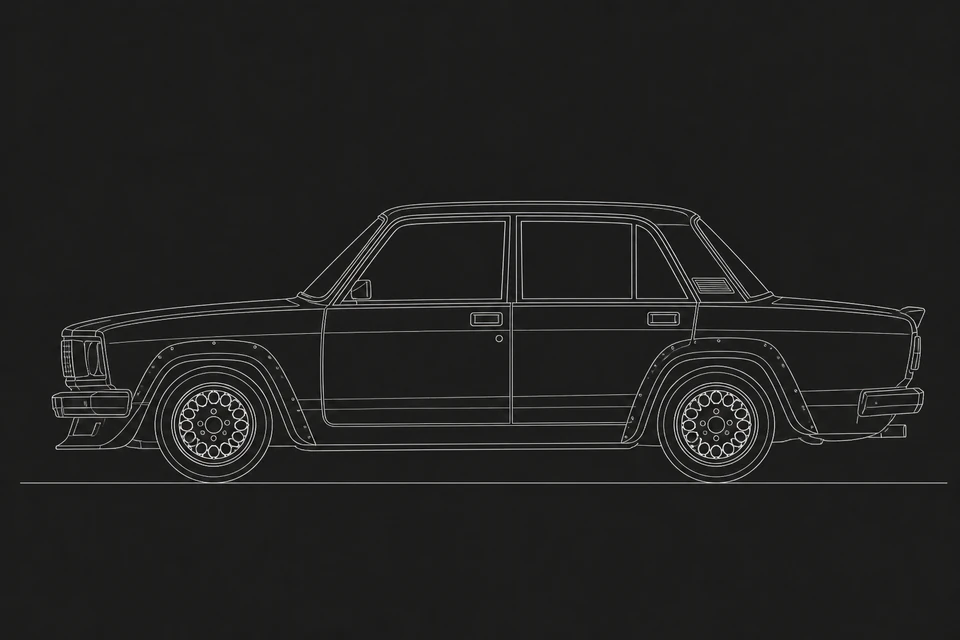
Legends of the Winding Roads (Kurvilise tee legendid, 2023) is the documentary about Estonian drivers behind the Iron Curtain and the restoration of four Lada VFTS rally cars, including Ilmar Raissar and Rein Talvar's machine. Tarvo Mölder directed; Sterotek produced. DirtFish called Harju KEK livery on Ilmar's car non-negotiable: "Harju KEK was the crack competition preparation team of the time."
Also: Sterotek film page · Wikipedia
